

You've likely heard of sourdough discard crackers for using up extra discard? With wild yeast…


Cranberry Walnut Wild Yeast Water Bread

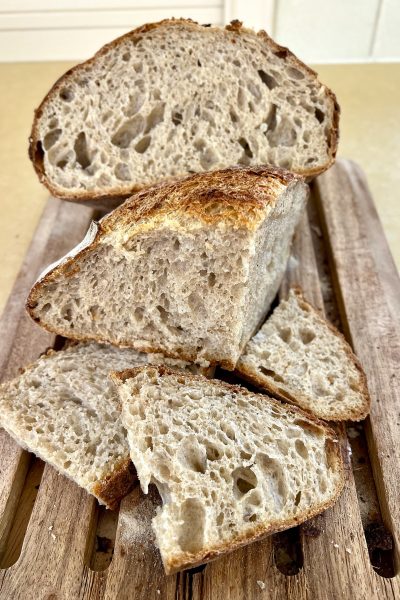
Welcome fall with this sweet, nutty, grainy, Cranberry Nut Wild Yeast Water bread. Enjoy toasted or untoasted, slathered with butter and honey, or topped with cheddar or goat cheese. I’ll show you the lamination technique for adding nuts and dried cranberries or other goodies to bread dough.
The recipe is my 2.0 Artisan-style bread with a little rye flour for added flavor, plus whole wheat and white bread flour, and lots of dried cranberries and chopped walnuts or pecans. As with all my Wild Yeast Water breads, there is ‘no knead’ to feed and discard a starter before baking — your Wild Yeast Water should be ready and waiting in the refrigerator! And if you haven’t made Wild Yeast Water yet, what are you waiting for?! Instructions here.
Once you’ve experienced the lamination method, go for it with your choice of ingredients like olives, cooked grain berries, other nuts and dried fruit, or get spicy with cheddar and jalapeno peppers. You can also bake this dough into rolls instead of a loaves. Let me know what you try!
PS: My right-hand bread baking tools are this High Capacity Baking Scale, Brod & Taylor Folding Proofer and Swedish Whisk. Brod & Taylor is also a great resource for equipment and recipes.


Cranberry Walnut Artisan Bread
This is a crusty long-fermented loaf packed with toasted walnuts or pecans and dried cranberries. The recipe is based on my 2.0 Yeast Water Artisan Bread Recipe Wild Yeast Water Artisan Bread- Simpler Than Sourdough! – Rosemary Mark. Two alternative methods are noted at the end of the recipe for making rolls or halving the recipe to make one plain loaf and one cranberry nut.
Servings: 2 loaves, about 2lb eachch
Ingredients
Preferment – make 12-24 hours before mixing Final Dough.
- 100 grams Wild Yeast Water, shaken before measuring, warmed to about 85F
- 50 grams whole wheat or rye flour Any combination of flours, total of 100g
- 50 grams bread flour
Final Dough – start 24 hours before you want to bake the bread
- 700 grams bread flour or all-purpose flour
- 200 grams whole wheat flour
- 550 grams tap water, or filtered water
- 100 grams wild yeast water If the preferment doubled in less than 10 hours at 75F, can reduce yeast water to 50 grams and add 50 grams tap water.
- 20 grams Kosher salt (preferred), or table salt
- 220 grams coarsely chopped walnuts or pecans, lightly toasted, optional
- 180 grams dried sweetened cranberries If cranberries are very dry, add 1-2tbsp hot water and stir well. Let stand while preparing dough.
Instructions
- MAKE PREFERMENT 24-48 hours before you want the baked bread. Stir together the 100 grams 85F Yeast Water and 100 grams choice of flour. The mixture will be thick enough to nearly hold a chopstick straight up for a couple seconds. Let stand at room temperature (65-75F) until at least doubled in volume with a slightly domed top. A very active water could double in 6-8 hours, but plan on about 12 hours. More or less time depending on temperature and yeast water strength. Once the preferment doubles, use or refrigerate for up to two days. Bring to room temperature before proceeding.
- Make the dough: Mix by hand or use a stand mixer. If mixing by hand, use instructions in Wild Yeast Water Artisan Bread- Simpler Than Sourdough! – Rosemary Mark.If using a stand mixer, add 700g bread flour, 200g whole wheat flour, 550g water and 100g wild yeast water to the mixing bowl. Stir by hand or slowly in mixer just until flour is moistened. Let stand 15-30 minutes. Continue with directions below.
- Add preferment and salt to the dough in stand mixer bowl. Since whole wheat flours vary in dryness, if the dough feels tight before adding the preferment, add additional 20g water, pouring it over the salt to help dissolve it.Mix on low speed (KitchenAid #2), for 5 minutes.Cover and let rest 30 minutes. This can be done at room temperature or in warm 75-80F proofing place. After 30 minutes mix again for 5 minutes on low speed. Cover bowl and set in proofing place for 30 minutes then start the folding. Note the time of mixing for reference to end of bulk fermentation.

- FOLDING: Do two folds, either coil or stretch and fold, about 30 minutes apart. Look for the dough relaxing and spreading, then do the next fold.
- LAMINATE the nuts and fruit: 30 minutes after the 2nd fold, spritz a clean large surface (at least 20×20 inches) with water. Lightly spritz the top of the dough in the bowl. Turn dough out with moistened top down, using a scraper to gently loosen around sides of bowl. Gently pull the dough with hands, working all sides to stretch into appx. 20-22 inch square or rectangle.
- Sprinkle 2/3 of the nuts and cranberries over 2/3 of the right-hand side of the dough, leaving left side clean. Fold the left third over, sprinkle remaining ingredients on top. Fold the right 1/3 side over the left. (alternatively, leave the folded top side empty, fold the right side over and sprinkle the remaining ingredients on top before rolling). Roll up starting at the short end, tucking dough to hold ingredients in. See links in notes below on laminating add-ins into dough.
- Return dough to warm place at least 75F-80F. Do one to two coil folds over the next hour. See coil fold demo in link below.
- Let dough continue to rise until doubled. This may be total of 5-7 hours or up to 8-9 hours, depending on the proofing temperature and the room temperature when laminating the cranberries and nuts.
- Gently release dough from bowl onto a moistened work surface, using a water moistened bowl scraper to ease dough out. Divide dough into two.
- Shape into boules and let rest about 15 minutes until dough relaxes. The dough pictured had a 1-inch space between the boules when first shaped, within 15 minutes the boules nearly touched. Dust tops of boules and bannetons with rice flour or all-purpose flour.
- The dough is rather stiff with the add-ins so simply turning the boules by clasping the edges and setting in the banneton with rounded side down seems sufficient, instead of structured shaping.
- A light criss-crossing (or stitching) by pulling thin piece of dough from opposite sides of the boule and tacking in the center adds a little tension.
- Cover with plastic (shower cap, plastic bag, or dough cover) and refrigerate for a cold proof, 12-24 hours. If making rolls with one or both doughs, go to step 16 for instructions, after the cold proof.
- BAKINGUse either option #1 Hot Baking, or option #2 Cold Baking method. Details of hot or cold bake method described here: Hot Bake or Cold Bake – your choice! – Rosemary MarkOption #1 Preheated oven, place cast iron or ceramic Dutch oven in cold oven on the highest rack that fits. Heat to 500F conventional or 475F convection (my oven takes 45 minutes). Turn dough out onto a rimless, parchment lined baking sheet. Score top of dough, then slide into hot pan. Immediately cover and return to oven. Reduce temperature 25 degrees. Bake 25 minutes covered; remove lid and bake additional 10-15 minutes or until deep golden brown. The last 5 minutes can place the loaf directly on the oven rack for extra crisp crust.NOTE: IF the bottom crust is too dark, next time pre-heat oven to 475F and bake at 450F. Can also try placing the Dutch oven on a baking sheet for insulation. Dutch ovens and your oven may heat differently than the pans I've tested.
- Option #2 Cold start oven, turn dough into unheated Dutch oven lined with lightly floured parchment or silpat. Dough might stick in the cold pan if not lined. Place pan in upper third of oven. Score top with a lam or sharp knife.Set oven to 475F convection or conventional. I find 475F is fine for convection or conventional. With practice you can choose temperature for your oven and results preference. Bake covered for 50 minutes. Remove lid and bake additional 5-10 minutes until crust is deep golden brown. Bake until well browned for the best crust and interior crumb.
- To Make Rolls: Turn a boule out on a dampened cutting board. Using a dampened bench knife or chef's knife, cut boule into 8 or 10 even sized wedges. Transfer to a parchment lined baking sheet. Brush tops with egg wash or water if desired. Bake about 15 minutes at 450F convection or 425F conventional until well browned, turning pan half-way through, and moving rolls as needed if edge pieces brown faster. It also works well to place pan in oven while preheating, when oven is about 325F, and continue to bake about 15-18 minutes as oven heats to full temperature.
- Cool loaves or rolls on a wire rack and try not to slice for at least an hour! Slicing a not loaf will compress the interior and change the texture of the crumb. The rolls are more forgiving about tearing into warm!
- To make half cranberry nut and half plain loaf:Divide dough in half in the lamination step. Use half the amount of cranberries and nuts. Place in separate bowls to proof, or as shown here in a divided pan in my Brod & Taylor folding proofer.


Leave a Reply