
Yeast Water Artisan Bread (2.0 version)
There are many ways to adapt bread formulas to suit your preference for types of flours, addition of nuts, herbs, seeds, or whole cooked grains. My recommendation is to begin with the basic formula below. Keep notes for yourself of any changes to my recipe as well as your room temp and proof times. Soon you'll be customizing your own recipe and I hope having as much fun as I do. And of course, enjoying and sharing fabulous bread!Note that this recipe is written in grams because measurements really do make a difference. I've provided some cup measures but I recommend to use a scale because cups vary significantly. Remember, you need to make the Yeast Water 5-7 days ahead of baking. Once it's made, only a portion is used for this recipe and the remainder keeps refrigerated until ready to bake again. Read here How to Make Wild Yeast Water - Rosemary Mark.Read through the recipe below to follow the two-day process with 'preferment' for exceptional bakery style bread, Or, stir up a batch of dough now using my Overnight No-Knead Yeast Water Bread - Rosemary Mark recipe for yeast water, and in 18 -24 hours it will be ready to bake. The quicker version without preferment is a little less 'bakery style' and is still a fabulous home-baked loaf.
Servings: 2 two 1-1/2lb loaves
Equipment
- Gram scale is preferable to measuring cups High Capacity Baking Scale – Brod & Taylor (brodandtaylor.com)I use this scale for everything
- Brod & Taylor Folding Proofer A proofing box allows control and accuracy. This conveniently folds flat for storage BROD & TAYLOR FOLDING PROOFER (brodandtaylor.com)
- Cast iron or enamel coated cast iron Dutch oven that withstands 500F oven.
- 6 quart cambro bucket or very large bowl
- Digital thermometer
- optional: dough scraper; plastic shower cap
- optional: Silpat bread sling http://bit.ly/48UPsMM
Ingredients
Preferment - make 12-24 hours before mixing Final Dough. This means up to 48 hours before baking.
- 100 grams Yeast Water,(~1/3c plus 1 Tbsp), shake before measuring and heat to 85-90F Instructions for making your first jar of yeast water How to Make Wild Yeast Water - Rosemary Mark
- 100 grams whole wheat spelt flour or whole wheat (~3/4 cup) or 50:50 any whole wheat or rye flour and all-purpose white flour
Final Dough - start 24 hours before you want to bake the bread
- 700 grams white bread flour (~5-1/2cups + 2Tbsp) all-purpose flour also works, I prefer the slightly more structured texture with bread flour.
- 200 grams whole wheat flour (~1 cup + 2Tbsp)
- 550 grams tap water or filtered water (~2-1/3 cups) or 600 grams water for softer/moister crumb
- 100 grams Yeast Water (~1/2 cup minus 1Tbsp), shake before measuring
- 18-20 grams salt (~2Tbsp Diamond Crystal Kosher salt) Less salt as low as 12 grams or to your preference. Other salts can be used such as gray salt or fleur de sel. Table salt can be used and is 3 tsp per 18grams.
Instructions
- MAKE PREFERMENT 24-48 hours before you want to bake bread.Stir together the 100 grams 90-95F Yeast Water and 100 grams whole wheat flour. The mixture will be thick enough to nearly hold a chopstick straight up for a couple seconds. Let stand at room temperature (62-75F) until at least doubled in volume with a slightly domed top. A very active water could double in 6-8 hours, but plan on about 12 hours. More or less time depending on room temperature and yeast water strength.Once the preferment doubles, use or refrigerate for up to two days. Bring to room temperature before proceeding.

- MAKE DOUGH 24 hours before planning to bake bread. In a 6-quart container or bowl, stir together the flours. Combine the tap water (or filtered water), and Yeast Water (photo shows cherry YW) in a bowl or 4-cup measure. Heat to 85-90F (in my microwave this takes 60-75 seconds), but no higher than 95F. In winter when the kitchen is cold, the flour could be about 65 degrees, or much warmer in summer; adjust water temperature accordingly.

- Stir together the flours and warmed Yeast Water mixture until all the dry and wet are just combined. No need to knead! Let stand 20-30 minutes or up to 1 hour. This is the autolyse stage which hydrates the flour and starts to activate the enzymes and the gluten forming proteins, improving the dough's ability to stretch and hold shape.

- Now pour the preferment and the salt over the dough.
- Begin the mixing by lifting and folding the dough over and scooping up from the bottom of the container. Then pinch across the dough making chunks, then refold over itself until all the ingredients are combined. This usually takes me 2-3 minutes.
- Let the dough rest 30 seconds, then do a couple more folds and let it relax into the bowl. Cover the container (plastic shower cap works well) and let stand at room temperature for 30 minutes. Ideal temperature is between 75-82F. If less than 70F, expect the dough to take a lot longer to proof.

- FOLDING: Now you'll start the series of three folds every 30 minutes (the time doesn't have to be exact, even an hour is ok). Here's how to fold: lift an edge of the dough as far as it will go pulling gently, then fold it over itself. Do this 4-6 more times around the bowl to make a smooth-ish ball.
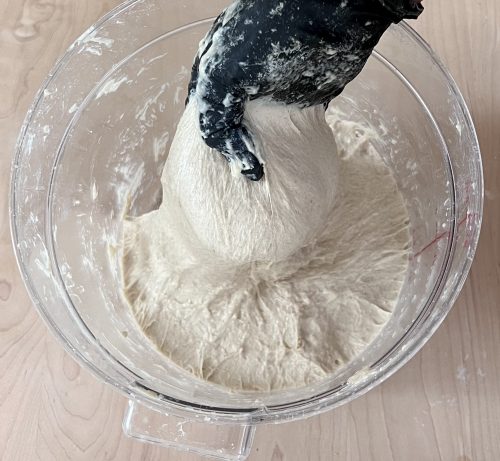
- The dough tightens with each stretch so the last time it barely stretches up. Cover and let rest again about 30 minutes. Repeat the stretching 3-4 times at interval of about 30 minutes, which will take about 2 hours. Don't stress if you let it go longer, just not more than 3 hours.

- PROOFING (also called bulk fermentation): Now cover the bowl and let it do it's thing. Time will vary greatly from 4 or 5 hours to 8-10 hours depending on room temperature. I set the container on a cloth, not directly on the cold countertop. Or, in a proof box such as this folding proofer and set the temperature to 75F. If I need it to go faster because of my schedule for shaping, then I use 78-80F. Up to 85F would be ok, but I prefer the lower temp which adds to flavor development.

- Be patient! Amount of rise is related to dough temperature. See notes*. If dough is on the cooler side, 65F, let it double the original volume. If 70-75F, let it rise about 75%. If dough is 75-80F, 30-50% rise is enough. Look for a slightly domed top and some bubbles on the surface. Also use the finger poke test by coating a finger with flour and indenting about 1/2-inch. Look for a slow rise back with the hole slowly enclosing. If it springs back immediately, it needs more time; if it doesn't spring back at all it is over-proofed.

- This is top-down view of well-proofed dough. Domed with visible bubbles.

- Photo below is very active dough; probably over-proofed. Over-proofing weakens the gluten which tends to reduce the final rise (called oven spring) during baking. It may be a denser bread, contrary to expectation of making a lighter bread from such big bubbles. This dough still made delicious loaves!

- Gently scrap the dough out of the container onto a floured work surface.

- Flour the center top of the dough and cut in half with a dough scraper or knife.

- SHAPING Make 3-4 gentle stretch and folds to shape each piece of dough into a rough ball. I prefer to do this on a slightly damp surface, some bakers use a lightly floured surface. Let rest 20-30 minutes. The dough should expand and bubbles form on surface. Then turn and tuck with hands or one hand and a bench scraper, moving around the ball several times to form a smooth and taught ball. Use little or no flour allowing the dough to create tension on the work surface. The dough will become more taught, and bubbles will form on the surface as the dough is rounded into a ball. Prick any very large bubbles as they tend to burn during baking. See the link in the notes below to Ken Forkish on YouTube for detailed instruction on folding and shaping dough. There are many different techniques!

- FINAL PROOFTurn into lightly floured cloth lined bowl or banneton, and cover with plastic. Refrigerate either covered with plastic or uncovered 8-16 hours*. I've left refrigerated up to 36 hours, and had variable results sometimes more or less open crumb.*If baking directly on Dutch oven, the dry surface helps prevent sticking. I usually bake on parchment or silpat liner, which prevents sticking, so I cover the banneton with plastic during cold proof. A shower cap, bowl cover, or plastic bag work well.

- Details of hot or cold bake method described here: Hot Bake or Cold Bake - your choice! - Rosemary MarkBAKINGOption #1 Preheated oven, place cast iron or ceramic Dutch oven in cold oven on the highest rack that fits. Heat to 500F conventional or 475F convection (my oven takes 45 minutes). CAREFULLY remove pan from oven and turn lightly flour dusted dough directly from bowl or banneton into the hot pan. OR, invert by covering with a sheet of parchment and turning out onto a rimless sheet pan or pizza peel, then sliding into Dutch oven.Score top (or a slash a smile!) with a lam or sharp knife, then immediately cover and return to oven. Reduce temperature 25 degrees. Bake 25 minutes covered; remove lid and bake additional 15-25 minutes until deep golden brown. NOTE: IF the bottom crust is too dark, next time pre-heat oven to 475F and bake at 450F. Different Dutch ovens and ovens can heat differently than the pans I've tested.

- Option #2 Cold start oven, turn dough into unheated Dutch oven lined with lightly floured parchment or silpat. Dough tends to stick in the cold pan if not lined. Place pan in upper third of oven. Turn on to 475F convection or conventional. I find 475F is fine for convection or conventional; with repetition you can choose for your oven and results preference. Bake covered for 50 minutes. Remove lid and bake additional 5-10 minutes until crust is deep golden brown.

- Bake until well browned for the best crust and interior crumb. For extra crisp crust and drier interior crumb, after removing from pan bake on rack additional 5-10 minutes.

- Turn out immediately on a wire rack and try not to slice the loaf for at least an hour! Slicing hot will compress the interior and change the texture of the crumb.

Notes
How to Make Yeast Water pdf
Ken Forkish YouTube: Shaping the Loaves - Bing video
Link to my Starter Water Baking Demo for the Bakers Dozen of San Francisco
For ready-to-eat in under 24 hours Link to Easiest Ever No Knead Bread
Quick guide to dough temp and percent rise Home | The Sourdough Journey
Bread flour vs all-purpose flour: If you only have all-purpose flour, go ahead and bake with it! Preferably unbleached but bleached will work also, the crumb may be finer with all-purpose vs bread flour.
I like to use Guisto's Malted Bread Flour which has a small amount of malted barley. Guisto's description. 'The addition of malt increases enzymatic activity during fermentation. This yields bread with greater volume without diminishing the integrity of the open crumb. It also increases the depth of color in your crust. This is the best organic malted bread flour for baguettes and sourdough breads of any shape and size. This flour also works very well in laminated doughs and quick doughs.'
When adjusting recipes, keep in mind that whole wheat flour takes in a little more water when hydrating. As little as 15-50 grams more or less water can make a difference. Best to keep notes on type flour and amount of water you use for your preferred results.
Water: Some recipes recommend filtered water. I have used my tap water and also my faucet filtered water, both with success.