
No-Knead Country Wheat Bread - plain, walnut or raisin
A gram weight kitchen scale is handy for measuring quickly and accurately.
Servings: 1 1-1/2lb loaf
Ingredients
- 420 g (3 cups) white bread flour, or all-purpose flour unbleached or bleached flour is fine
- 90 g (3/4 cup) whole wheat flour
- 30 g (1/4 cup) oat bran, or rye flour optional
- 8 g (1-1/2 tsp) table salt
- 1/4 tsp Rapid rise yeast I use a generous 1/4 tsp.
- 70 g (1 cup) chopped walnuts optional and/or 3/4 cup raisins
- 400 grams (1-3/4 cup) water hot water for fast rise, see first instruction below
For Seeded Bread
- 1/4-1/2 cup choice of un-toasted sunflower, pumpkin, sesame seeds
Instructions
For a speedy version, with 3-5 hours rise vs 12-18 hours, use hot water (115-120F) and add 1/4 teaspoon red wine vinegar, per directions in video by Mark Bittman. (see link in text above)
- Mix dry ingredients in a large bowl. Add walnuts, raisins, and/or soaked grains if making multi-grain recipe. (See link for multi-grain recipe and step-by-step photos.)
- With a wooden spoon, stir in water. (For speedy rise, use hot 115-120F water plus 1/4 tsp. red wine vinegar). Switch to a plastic scraper if you have one, and continue mixing and turning just until dough is evenly moistened and pulls away from sides of the bowl. It’s not necessary to stir vigorously, just enough so the flour is mixed in.

- Cover bowl with plastic wrap (a plastic shower cap works great!) and let stand 30 minutes. Turn dough with the scraper or spoon, giving it about 4 folds and stretching the dough as you turn it. (If you forget this step, the bread will still be good, but this adds to the gluten development and texture).
Cover bowl with plastic and let stand at room temperature 18-24 hours (3-5 hours for speedy version). The dough will rise and be very bubbly. Temperature of room has a direct affect on rise time. 75-80F will rise faster than 65F. I often place the bowl in the oven with the light on for about 30 minutes then turn it off and leave the door closed. Temp is usually 75F, but gets to 100F if the light is on a long time. 100F is a bit hot for dough.
- Gently stir dough down with scraper or spatula and stretch and fold over in 90 degree turns several times. Dust top of dough lightly with flour. Cover the bowl and let rest 15 minutes.

- Dust a towel with oats, cornmeal, wheat bran or a little flour. (If using seeds, skip this step and coat with seeds when placing in casserole, moistening dough to help the seeds to stick. See below.). Scrape the dough out of the bowl onto the towel and shape roughly into a ball. Wrap in the towel and leave at room temperature for 30-45 minutes. OR – skip the towel, leave it in the bowl and lightly scrape around edges. After 30-45 minutes, transfer directly to pre-heated Dutch oven, as instructed in the following steps.

- While dough is resting, place ungreased pan with lid, if it has one, in the oven. Turn oven on and preheat to 500°F. NOTE: The pan must be a glazed ceramic that can withstand 500°F, or an iron skillet. Allow at least 30 minutes for pan and oven to super-heat. It is necessary to preheat the pan so the bread will instantly create steam when it goes in, and the bread won’t stick to the pan.
- Unwrap dough; shake excess grain off the towel. Place the dough wrapped in the towel within reach of the oven. Open oven and pull rack forward, or remove pan from oven. Quickly slide dough into pan.If adding seeds, generously spritz dough with water and sprinkle with seeds. Photo shows dough first rolled into balls with moistened hands to produce a pull-apart loaf. Cover casserole with lid or loosely with foil. (If you remove the pan from the oven be sure to use hotpads for pan and lid.)
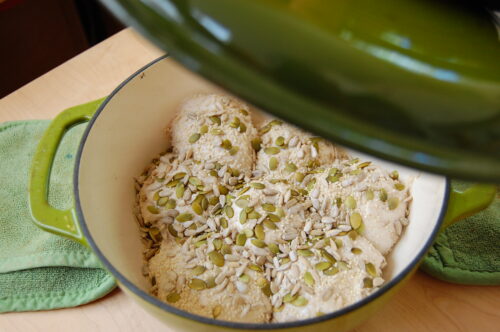
- Reduce oven to 450°F. Cover pan with lid or foil. Bake covered 25 minutes. Dough will rise and start to brown. It is half-baked at this point.
- Remove lid or foil and continue to bake until very dark brown, another 20-25 minutes. Immediately remove bread from pan and cool on a wire rack.

Video
Notes
The website PotsandPans.com sells ceramic loaf pans like the one I used for the walnut-raisin loaf.
I've tested cider vinegar in place of red wine and it seems to work similarly. I have a question in to Mark Bittman about why red wine, but he's traveling in India till end of February and I've not had a reply. I haven't found food chemist to answer the question yet :)